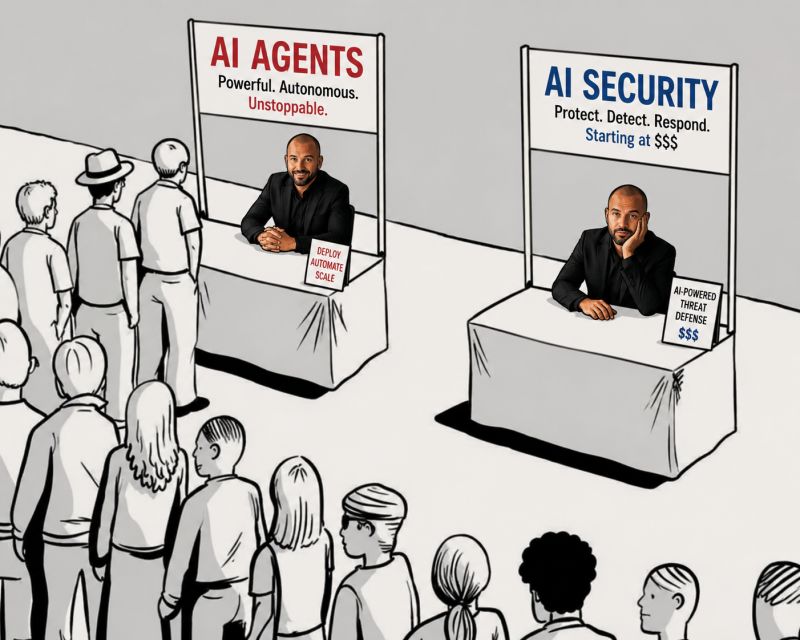
The most dangerous AI system in your company may be the one with no intended public access. Because nobody gave it the same security scrutiny.
Customer-facing AI gets threat models, security reviews, access controls, and executive attention. Internal AI gets built in a sprint because someone wants a smarter way to search SharePoint.
Then it gets connected to Slack, internal APIs, cloud services, databases, model providers, and MCP tools.
By Friday, the “internal assistant” has access to more of the company than the person who approved it.
That is the hidden risk.
Internal-facing does not mean low-risk
Teams often think of internal AI as a productivity feature. Attackers see something else: a new control plane with a concentrated collection of credentials, permissions, data, and pathways into the business.
The risk is not limited to an assistant producing a bad answer. AI infrastructure can read, reason, retrieve, and act across systems that used to be separated by applications, permissions, and the ancient enterprise security control known as “nobody knows how that system works.”
That changes the attack surface.
An AI agent may read a ticket, a document, or a webpage containing untrusted instructions. If it has tools, those instructions may try to influence what it does next. A proxy or gateway may hold provider keys, cloud credentials, and configuration that point directly to the next system. An MCP server meant to make a tool easier to use may be weakly authenticated or expose more capability than anyone realized.
The system does not need to be public for this to matter. A compromised internal identity, poisoned internal content, or exposed service can be enough.
Why internal AI gets missed
It starts small. Someone builds a proof of concept. It is useful. More people ask for access. It gains a new connection. Then another. Nobody intentionally designed a high-privilege system. The company just slowly assembled one.
That is why security reviews cannot focus only on the chat interface. The meaningful questions live underneath it:
- What identities does the AI use?
- What data, APIs, tools, and environments can it reach?
- What happens when it reads untrusted content?
- Can it call external endpoints or move data outside the environment?
- Are secrets isolated and rotated?
- Can the organization see actions at runtime and stop them quickly?
If the answer is “it is only internal,” the review has not started yet.
Build the controls into the stack
The fix is not slowing every internal experiment into oblivion. It is treating the AI stack as first-class production infrastructure before it becomes the most connected thing in the company.
Start with the basics:
- Know what exists. Keep an inventory of agents, MCP servers, tool connections, models, owners, and environments.
- Authenticate every component. No anonymous internal services because the network “feels safe.”
- Use least privilege. Give an agent the smallest set of data and actions needed for its job, not a shared service account with a heroic backstory.
- Control outbound access. Limit where agents and tools can send data or make calls.
- Protect secrets. Keep keys out of prompts, code, logs, and process memory where possible; rotate them when exposure is suspected.
- Watch runtime behavior. Log tool use, unusual retrieval, permission changes, failures, and escalation events.
The real question is not, “Can employees use this safely?”
It is, “What happens when this thing gets manipulated after we gave it the keys?”
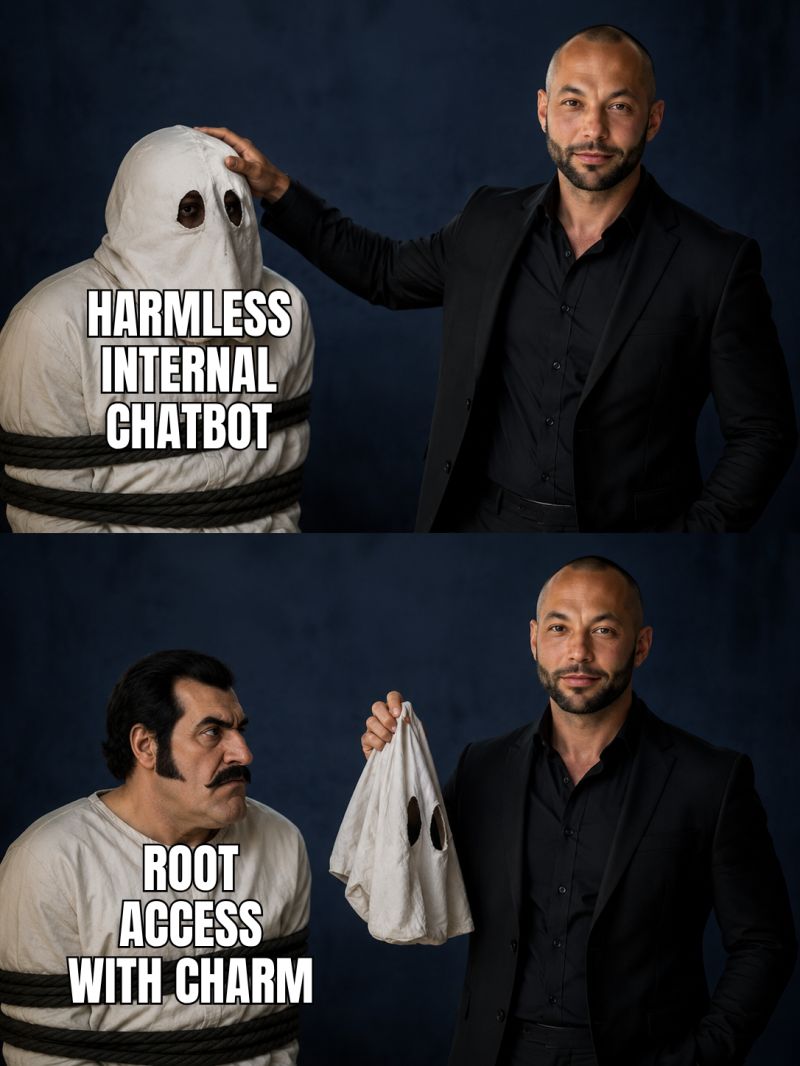
Internal AI often begins as a harmless chatbot. So did plenty of systems that later became business-critical because nobody meant for them to.