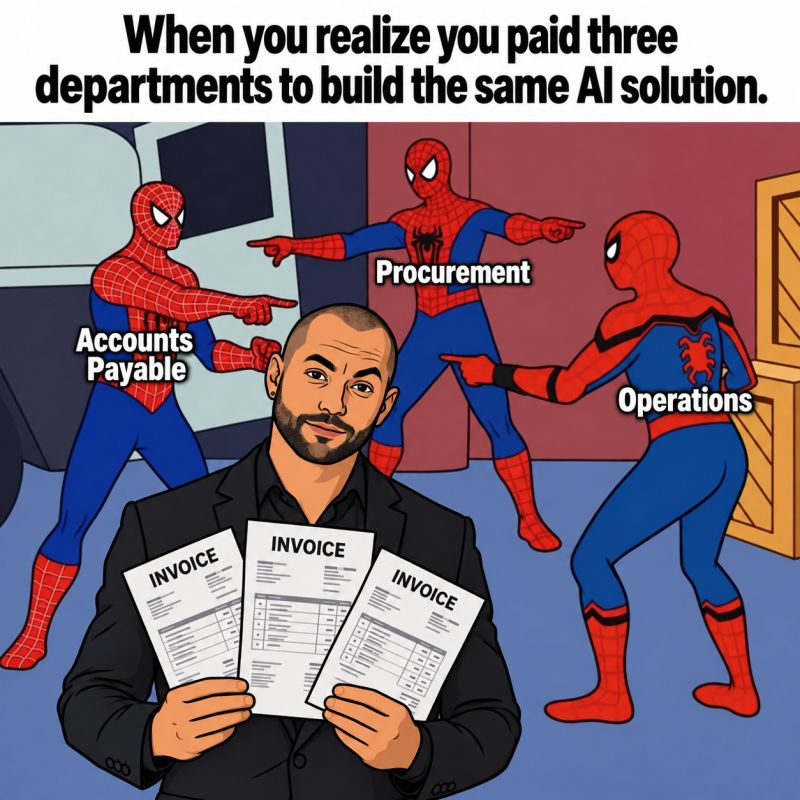
The problem I keep solving lately for clients is creating the ability to share AI assets inside an organization.
AI has made it easier to build with AI: skills, MCPs, agents, prompts, workflows, and little pieces of software that solve a real problem for one person on a Tuesday afternoon.
That is a good thing. Until 20 people build the same thing, each with their own data connection, logic, permissions, and vibe-coded personalization.
Then we are right back in the spreadsheet era.
Everyone has their own version. Everyone spent time building it. Nobody knows which one is right. And the person who built the useful one is suddenly the only person who knows why it breaks every third Thursday.
AI assets are becoming enterprise assets
A useful internal agent is not just a prompt. It may contain a connection to a system, a trusted data source, business rules, evaluation criteria, guardrails, and a workflow someone learned by doing the work for years.
That is organizational knowledge. It should not live only in one employee’s chat history, local files, or Slack message from six months ago.
The problem is not that employees are building. The problem is that most larger organizations have no way to answer a few basic questions:
- Does this capability already exist?
- Who owns it and maintains it?
- What systems and data can it access?
- Which version is approved for other people to use?
- What happens when the person who built it changes roles?
Without those answers, adoption creates a strange form of technical debt. The company is not short on AI. It is short on shared AI.
The spreadsheet comparison gets more serious
Private spreadsheets were painful because they created competing versions of the truth. AI assets can create competing versions of the workflow.
One team builds a skill that explains a financial variance. Another builds an agent against the same source data. A third connects a similar tool to the wrong report. A fourth improves the wording but gives it broader permissions. Pretty soon the business has four answers to the same question and a meeting to decide which robot is allowed to be confident.
Unlike a spreadsheet, these assets can also call APIs, read sensitive information, take actions, and produce output that looks much more official than it deserves.
What a shared capability layer looks like
The answer is not shutting down experimentation or routing every idea through a six-month committee. That would just move the building somewhere harder to see.
The answer is giving people a place to publish and reuse what they build.
- A searchable catalog for skills, MCP connections, agents, prompts, and workflows.
- Clear ownership, version history, and a way to see what an asset connects to.
- Approved components people can reuse instead of recreating from scratch.
- Lightweight testing and guardrails for assets that touch meaningful data or systems.
- Usage visibility, so the organization knows what is valuable, duplicated, or ready to retire.
That turns personal experimentation into organizational capability. It also means the next person can improve the asset instead of rebuilding it because they never knew it existed.
AI lowers the cost of building. It does not lower the cost of coordination.
The organizations that solve that coordination problem will get compounding value from what their people create. Everyone else will have 20 nearly identical agents, a rapidly growing token bill, and the modern equivalent of asking who owns final_final_v7_revised.xlsx.