A client told me they needed a better prompt. They were wrong.
The prompt was not the problem.
The problem was that nobody could explain what success looked like.
That is where a lot of enterprise AI work is quietly breaking. Teams keep asking, “How do we prompt this better?” But the real question is, “How does the system know when it is done?”
Those are very different problems.
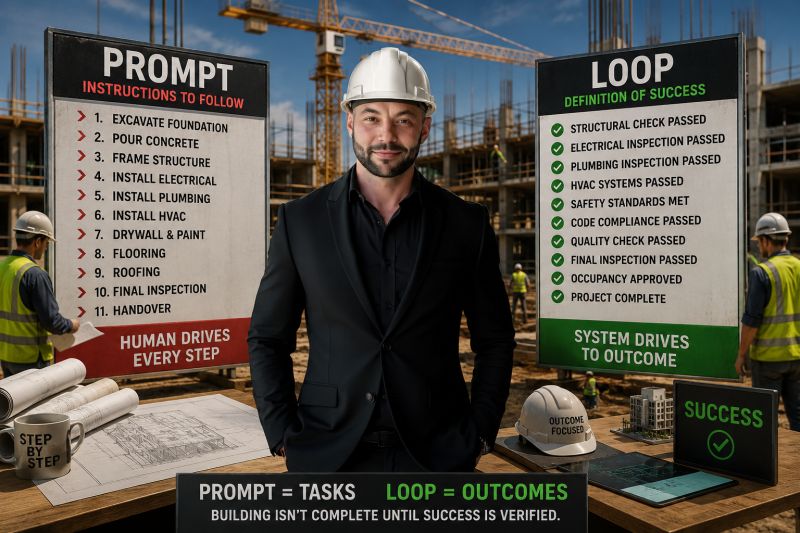
A prompt tells AI what to do. A loop tells AI how to know whether it did it correctly.
Prompts Still Matter, But They Are Not the Whole System
At a technical level, loops still contain prompts. That part is important. The distinction is not that prompts disappear. They do not.
The distinction is that the prompt stops being the primary unit of work.
In prompt-centric work, the human keeps deciding what happens next. The human gives one instruction, waits for the answer, evaluates it manually, and then gives the next instruction. The prompt contains the logic. The AI performs the task directly in front of it.
That can be useful. It is also limited.
If the human has to guide every step, inspect every output, decide every retry, and manually determine when the work is finished, then the AI is not really operating as a system. It is acting more like a very fast assistant waiting for the next instruction.
Prompt-Centric Work vs. Loop-Centric Work
Prompt-centric work sounds productive:
- Review this contract.
- Now summarize the risks.
- Now check the data-sharing clause.
- Now look for renewal terms.
- Now write the email to Legal.
The AI may perform each step well. But the human is still driving every turn.
Loop-centric work is different. The human defines the outcome:
Review this vendor contract until it meets our approval criteria.
Now the system has to evaluate the work. Did it identify the obligations? Did it check data-sharing terms? Did it flag unusual security language? Did it review renewal and termination risk? Did it escalate anything non-standard? Did it produce the final summary for Procurement and Legal?
That is not just a better prompt. That is a better operating model.
The Loop Contains the Logic
A loop is not magic. It is a feedback system.
The system analyzes the current state, takes an action, verifies the result, retries when needed, escalates when appropriate, and stops when the success criteria are met.
That final part matters: stops when the success criteria are met.
Without a definition of done, an AI system can generate, summarize, rewrite, retry, and revise forever without actually creating business value. This is how teams end up with impressive demos that still require a human to babysit the workflow.
The loop is where the operating logic lives. It defines what good looks like, what evidence is required, what should happen when the system is uncertain, and when the work is complete.
The GPS Analogy
Think about GPS navigation.
A prompt is telling the driver: turn left, turn right, take exit 12.
A loop is saying: get me to Boston.
There is still an instruction. But the system is constantly checking where it is, what changed, and what to do next. It asks whether it has reached the destination. It reroutes when traffic changes. It keeps evaluating the gap between the current state and the desired outcome.
The intelligence is not only in the initial command. It is in the feedback cycle.
That is the shift enterprise leaders need to understand.
From Prompt Engineering to Goal Engineering
This is why prompt engineering is becoming too small of a frame.
Prompt engineering asks, “What should I tell the AI?”
Goal engineering asks, “How will the AI know it succeeded?”
That second question is harder. It requires more than clever wording. It requires understanding the workflow, the data, the decision points, the quality standard, the escalation path, and the business outcome.
This is why enterprise AI cannot be solved by prompts alone. Enterprise work is full of approvals, exceptions, policies, edge cases, handoffs, missing context, and undocumented judgment. If those things are not designed into the loop, the AI will eventually expose the gap.
Usually in production. Usually when someone important is watching.
Why This Matters for Enterprise AI
The companies that get this right will not just write better instructions. They will define better outcomes.
They will know what good looks like. They will define completion criteria. They will build verification into the workflow. They will decide when the system should retry, when it should escalate, and when it should stop. They will make ownership clear.
That is how AI moves from task assistance to outcome-driven work.
Next time an AI solution is struggling, the answer may not be a better prompt. The better question may be whether the system was given a loop at all.
A prompt can start the work.
A loop makes the work outcome-driven.