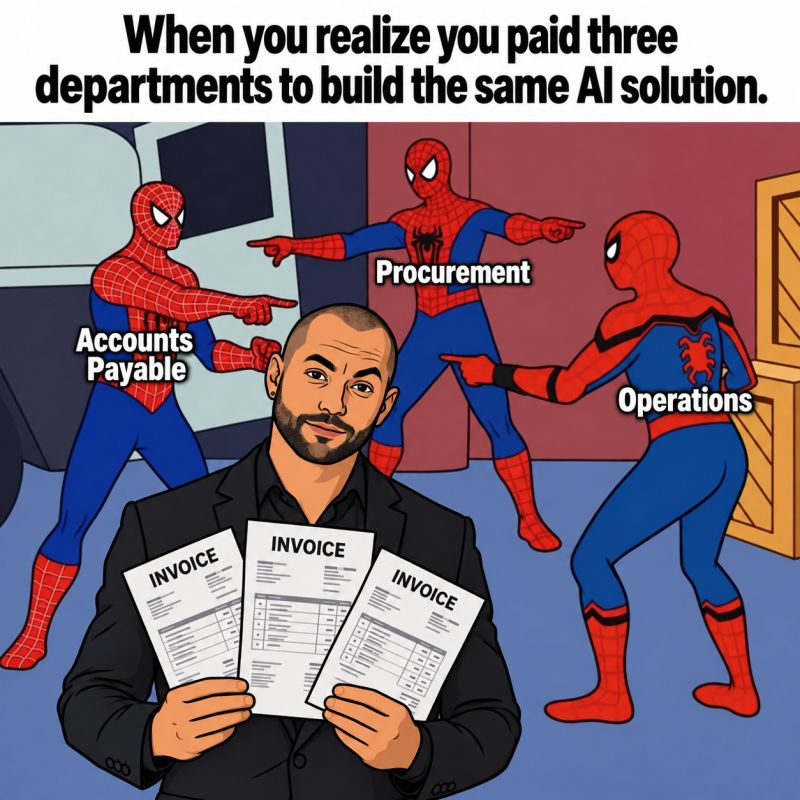
We have officially reached peak AI era: using AI to write reports about AI, which then hallucinate how other companies use AI.
The most dangerous AI hallucination is not the obvious one.
It is the one that looks like it went through Legal.
Clean formatting. Credible branding. Confident language. A footnote that looks real enough to stop you from asking questions.
That is where AI risk gets expensive.
According to the Financial Times, KPMG recently released a report on agentic AI that included false claims about how organizations including UBS, Transport for London, and the NHS were using AI agents. The report was about AI adoption. And parts of it appear to have been undermined by AI hallucinations.
Painfully ironic? Yes.
Predictable? Also yes.
Because the real failure was not only that AI made something up. AI does that. The real failure was that the claim survived the workflow that was supposed to catch it.
The Risk Is Not Just the Model
Most companies are still treating AI governance like a model-control issue. They focus on prompts, model selection, access policies, and acceptable-use guidelines. Those things matter, but they are not enough.
The deeper problem is the trust chain.
An AI-generated claim does not usually go straight from a model into the market. It moves through a series of handoffs. A prompt becomes a paragraph. A paragraph becomes a deck. A deck becomes an executive review. The review becomes publication. Publication becomes “industry insight.”
Along the way, the original uncertainty can disappear. The claim becomes more polished, more formatted, and more credible-looking. Eventually the logo does the work the evidence was supposed to do.
That is the uncomfortable part.
AI Makes Weak Processes Louder
The lesson is not “never use AI.” That is the lazy takeaway.
The lesson is that AI changes the quality-control model.
If a team is using AI to produce client-facing work, research, sales material, thought leadership, recommendations, analysis, or executive reporting, the validation process cannot be informal. It cannot be “generate, skim, approve.” It cannot depend on someone noticing that a footnote feels suspicious after the report has already been dressed up for publication.
AI does not just make strong teams faster. It makes weak processes louder.
If your review process is rigorous, AI can create leverage. If your review process is theater, AI turns that theater into high-volume production.
More decks. More claims. More confident language. More professionally formatted liabilities.
This Matters Especially in Consulting
In consulting, this risk is even more serious because the product is not the report.
The product is judgment.
The report is just the delivery mechanism. The deck is the artifact. The real value is supposed to be the credibility behind the recommendation, the sourcing behind the claim, and the experience behind the interpretation.
If the judgment layer becomes “generate, skim, approve,” the firm is not scaling expertise. It is scaling reputational risk very efficiently.
That does not mean consulting firms should avoid AI. Quite the opposite. AI can help consultants research faster, synthesize more effectively, explore edge cases, generate scenarios, and improve the speed of delivery.
But the more AI participates in the work, the more important the trust layer becomes.
The Trust Layer Has to Be Designed
For AI-assisted work, source validation cannot be optional. Claim review cannot happen only at the end. Evidence standards cannot live in someone’s head. Review paths cannot depend on whether the person approving the work has enough time to click every citation.
The trust layer needs to be designed into the workflow.
That means teams need clear rules for which claims require evidence, which sources are approved, how citations are verified, who owns the final answer, and what should never leave the building without proof. It also means distinguishing between low-risk AI assistance and high-risk client-facing claims.
Not every AI output needs the same level of review. But every organization needs to know where the line is.
That is not bureaucracy. That is quality control for a world where everyone has a research assistant that sometimes invents reality with excellent grammar.
The Real Enterprise AI Lesson
The KPMG story is not just a funny example of AI irony. It is a warning about how quickly AI-generated uncertainty can become organizational confidence when the workflow is not built to preserve skepticism.
That is the fundamental enterprise AI challenge.
AI adoption is not only about access to better tools. It is about redesigning the processes around those tools so the organization can move faster without lowering its standard for truth.
A good workflow turns AI into leverage.
A bad workflow turns it into a professionally formatted liability.
The hallucination is embarrassing.
But the unchecked handoff is the real disaster.