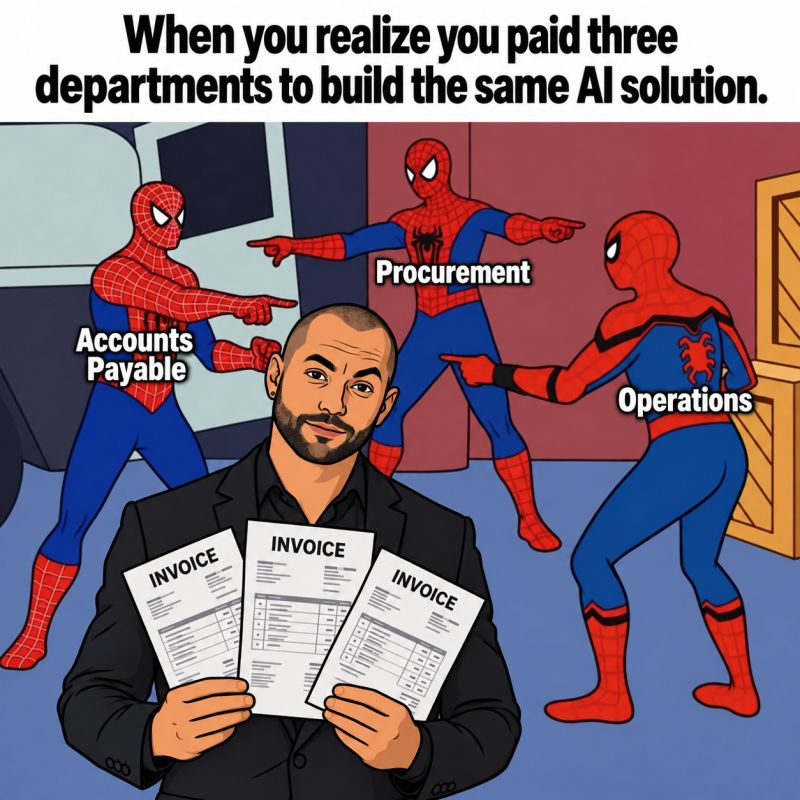
Last week, an AI model disappeared. Without warning, without notice.
Not your data. Not your team. The entire foundational AI model.
That is the nightmare nobody puts on the architecture diagram.
Anthropic’s most powerful models have recently faced access restrictions, suspensions, retirements, and availability issues that left many organizations scrambling. The lesson is not about Anthropic specifically.
It is about dependency.
Imagine explaining this to your CEO: “Good news, our AI-powered support platform is working perfectly. Bad news, the brain we rented yesterday is not available today.”
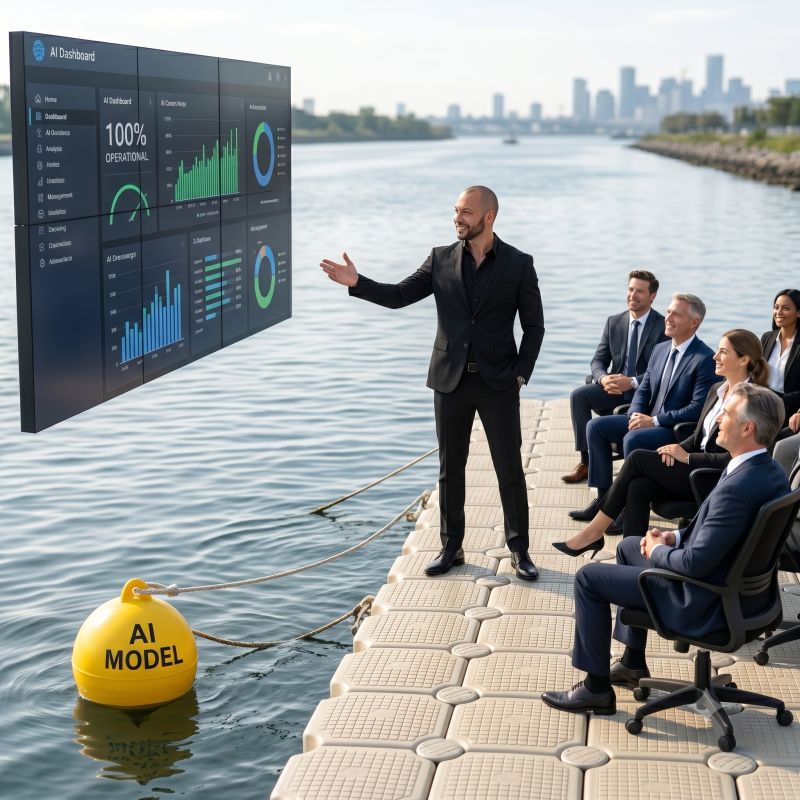
That is the enterprise equivalent of building your headquarters on a rented floating dock. Looks great until the tide changes.
The Hidden Risk in AI Architecture
Many organizations are spending months evaluating prompts, benchmarks, token costs, and model performance. Those things matter. But then they connect entire business processes to a single model provider with no failover, no routing layer, and no backup plan.
Just hope.
And hope is not a disaster recovery strategy.
This becomes especially dangerous as AI moves from experimentation into operations. A chatbot going down is annoying. An AI agent failing mid-process can interrupt support, sales, internal workflows, compliance review, engineering pipelines, or revenue-generating automation.
The risk is not only that the model gives a bad answer. The risk is that the system cannot operate when the model changes, degrades, disappears, gets restricted, or becomes commercially impractical.
Model Choice Is Not the Same as Model Resilience
There is a difference between choosing the best model for a use case and designing an AI system that can survive model failure.
Model selection asks: Which model performs best today?
Model resilience asks: What happens when that model is unavailable tomorrow?
That second question is where many AI strategies are still immature.
Enterprises already understand redundancy in other parts of the business. They plan for cloud outages, database backups, network failures, security incidents, vendor risk, and disaster recovery. Many organizations spend more time planning coffee machine redundancy than AI redundancy.
But when it comes to AI, the architecture often quietly assumes the model will always be there, always perform the same way, always have the same terms, always support the same workflows, and always remain economically viable.
That is not architecture. That is optimism with an API key.
What Breaks Without AI Failover
Without failover, a model issue does not stay contained inside the AI layer. It spreads into the business process.
Customer support stops responding or drops to a lower-quality workflow. Sales copilots go silent during active opportunities. Internal workflows break because the “assistant” was actually coordinating work. Agents fail mid-process. Revenue-generating automations halt. Engineering teams become emergency response teams for a dependency nobody treated like production infrastructure.
This is the part leaders need to internalize: once AI is embedded in execution, model availability becomes business availability.
If the model is supporting a noncritical experiment, downtime may be acceptable. If the model is supporting an operational workflow, customer journey, compliance process, or revenue motion, downtime becomes a business continuity issue.
What a Real Failover Strategy Looks Like
A proper AI failover strategy does not mean every system needs every model, every provider, and every possible routing option from day one. That would be expensive and unnecessary.
It means the organization understands which AI workflows are business-critical and designs appropriate resilience around them.
If Model A disappears, traffic can route to Model B. If Provider A degrades, the system can switch to Provider B. If costs spike, workloads can be redirected. If compliance requirements change overnight, the organization can keep operating without rebuilding the workflow from scratch.
The user should not need to know any of this happened. Resilience is invisible when it works.
That usually requires a few architectural capabilities:
- A routing layer that can direct requests across models or providers based on availability, cost, latency, risk, and task type.
- Clear abstraction so the business workflow is not hardwired to one provider’s API, prompt format, or behavior.
- Evaluation and regression testing so backup models are not theoretical. They are tested against the work they may need to perform.
- Operational monitoring for model quality, availability, latency, cost, and drift.
- Governance that defines which use cases require redundancy and which can tolerate failure.
This is not overengineering. It is treating AI like production infrastructure when AI is being used in production.
The Market Is Teaching a Simple Lesson
The market is teaching us a lesson in real time: models are becoming commodities. Availability is not.
There will always be a best model today. There will also be a new best model tomorrow. Providers will change pricing. Access will change. Terms will change. Safety policies will change. Models will be deprecated. Some will go down. Some will become unavailable for reasons your business does not control.
That does not mean companies should avoid powerful models or refuse to build with leading providers. It means they should avoid pretending the provider is the architecture.
The provider is a component. The operating model is the architecture.
The Real Question for Leaders
The question is not whether every AI workflow needs multi-provider failover. Some do. Some do not.
The real question is whether the organization knows the difference.
Which AI systems are experimental? Which are operational? Which are customer-facing? Which are revenue-impacting? Which can fail quietly, and which would create a real business problem if the model disappeared tomorrow?
Those questions should be answered before the workflow becomes critical, not after an outage turns the AI roadmap into an incident response meeting.
When your AI provider sneezes, your business should not need intensive care.
Build for model failure.
Because eventually every model fails, changes, gets restricted, gets deprecated, or goes down.
The question is not if.
It is whether your customers notice when it does.