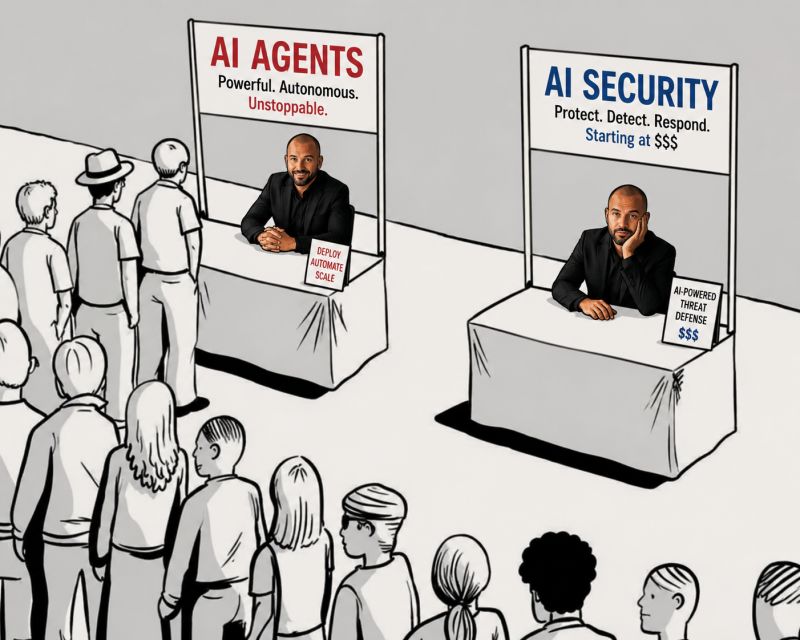
If your organization claims “We are an AI company” but you just gave everyone a Copilot subscription, I have news for you: you are not an AI company.
You may be an organization that bought AI access. You may have a workforce with a new tool in the browser bar. You may even have a few teams experimenting with prompts, summaries, slide drafts, and email rewrites.
But access is not advantage.
Somewhere along the way, “doing AI” became giving everyone a chatbot, sending around a few prompt tips, and calling it transformation. That is not transformation. That is tool distribution.
It is the same logic as saying, “We have email, so we have great communication.” No. You have infrastructure. Outcomes are a different conversation.
The Copilot rollout is not the finish line
Copilots are useful. Chatbots are useful. General-purpose AI tools can absolutely help people move faster at certain tasks. The problem is not the tool. The problem is pretending the tool, by itself, changes how the business operates.
Inside many companies, the actual pattern looks like this:
- Employees open a shiny AI tool.
- They use it to rewrite an email.
- They summarize a document.
- They generate a slide or two.
- Then they go right back to the same broken workflow.
Same approvals. Same manual handoffs. Same spreadsheet archaeology. Same copy-paste work between systems. Same waiting on someone to update a status field. Same weekly meeting where people manually reconstruct what the systems should already know.
Only now, the typing is slightly faster.
That is not an AI company. That is a traditional operating model with AI autocomplete sprinkled on top.
Real AI organizations start with the work, not the tool
Companies that actually do AI do not begin with, “Which subscription should we buy?” They begin with a much more uncomfortable question:
What work should not exist anymore?
That question changes the entire conversation.
Instead of asking how AI can help someone write a better status update, they ask why the status update has to be written manually in the first place. Instead of asking how AI can summarize a meeting, they ask why the meeting exists if the underlying systems can surface the decision, risk, owner, and next action automatically. Instead of asking employees to become better prompt writers, they redesign the process so AI is embedded where the work already happens.
That is the shift: from AI as a sidecar to AI as an operating capability.
Tool distribution keeps the old workflow alive
The easiest AI strategy is to give everyone access and hope productivity appears. It feels democratic. It feels fast. It produces adoption charts. It creates a nice internal announcement.
But it also avoids the hard part.
The hard part is admitting that many business workflows are not slow because employees lack a chatbot. They are slow because the workflow itself is poorly designed. Decisions are fragmented. Data is trapped. Accountability is unclear. Systems do not talk to each other. The “process” is really a chain of humans compensating for broken architecture.
AI can make that mess move faster, but faster mess is still mess.
If all an organization does is hand people generic AI tools, it risks standardizing mediocrity at higher speed. Everyone gets better at producing more words, more slides, more drafts, more summaries, and more noise. Meanwhile, the actual bottlenecks remain untouched.
What AI capability actually looks like
Real AI capability is not measured by how many employees have logins. It is measured by whether work changes in a way the business can feel.
That usually means organizations are doing things like:
- Building internal tools tailored to specific workflows, instead of forcing every team to improvise with a generic chatbot.
- Integrating AI into systems employees already use, so intelligence appears inside the flow of work instead of becoming another tab to manage.
- Training teams on decision-making, not just prompting, because the real leverage comes from knowing when to trust, challenge, escalate, or automate an output.
- Putting governance and validation in place, so AI outputs can be reliable enough for repeated operational use.
- Measuring business impact in time saved, cost reduced, throughput gained, cycle time improved, quality increased, and customer experience strengthened.
That is a different level of ambition than “we bought licenses.”
It requires product thinking. It requires process redesign. It requires data discipline. It requires security, governance, and change management. It requires leaders to stop treating AI as an employee perk and start treating it like business infrastructure.
The advantage is in the redesign
There is no durable advantage in having the same tools your competitors can buy with the same procurement process.
The advantage comes from how deeply you understand your own work, how aggressively you remove low-value activity, and how well you build AI into the operating model.
Reports should not simply be easier to write. In many cases, they should generate themselves from governed data and known business logic.
Decisions should not simply get better summaries. The right context, risks, options, and recommended next actions should be assembled automatically.
Teams should not simply create more content. They should spend more time on judgment, prioritization, customer understanding, and execution.
That is where AI becomes meaningful. Not when employees can ask a chatbot for help, but when the organization removes friction from the way work actually gets done.
Access is a feature. Capability shows up on the P&L.
Roll out the copilots. Give people access. Encourage experimentation. Those are reasonable steps.
Just do not confuse them with the destination.
If your AI strategy stops at access, you are not building an AI company. You are giving the old company a faster keyboard.
The companies that win will be the ones that redesign the work, rebuild the workflows, govern the outputs, measure the impact, and use AI to make the business operate differently.
One is a feature.
The other is a capability.
And only one shows up on the P&L.