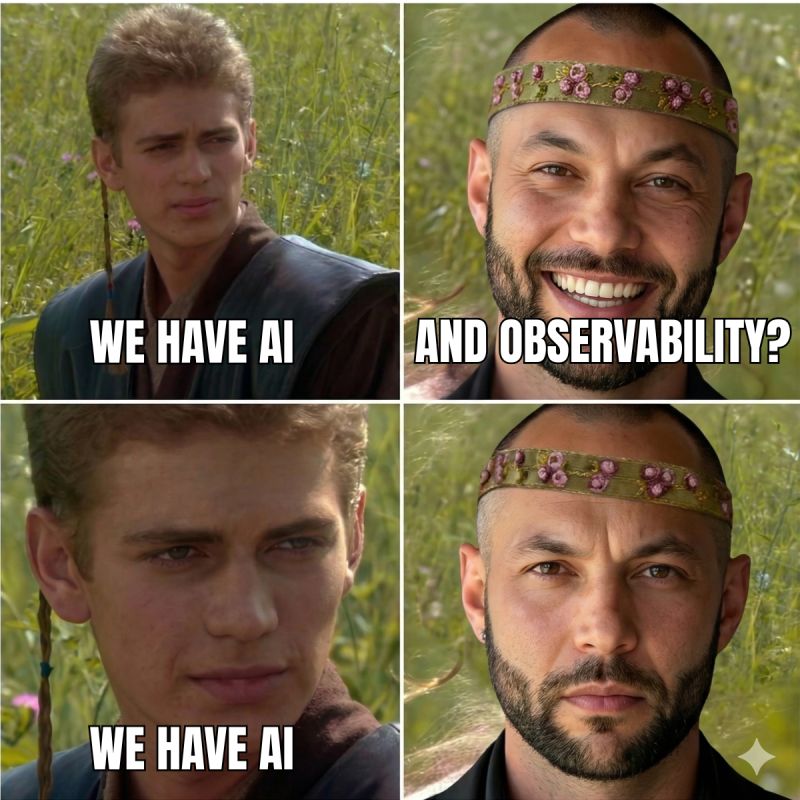
If you don’t have observability you are not doing AI. You are doing vibes.
You would never try to get healthy by staring at a salad and hoping the calories feel intimidated.
You track food because you want ROI. Energy in. Energy out. Results.
Same thing with a car. You do not wait for smoke to tell you the oil was low.
Data and AI are no different, except they fail in a way that is way more annoying because they keep working, just badly.
Your dashboard looks fine. Your model is still serving predictions. Your chatbot is still confidently answering questions.
Then sales starts asking why conversions dipped, support tickets spike, and someone says the most expensive sentence in business: “That’s weird. It worked yesterday.”
Observability is the difference between a system you can trust and a system you babysit.
AI failures are sneaky (because “up” is not the same as “healthy”)
In traditional software, a lot of failure modes are obvious. Servers go down. Error rates spike. Pages stop loading.
In data and AI, many failure modes look like success at the infrastructure level. Everything is running, but the outputs are wrong enough to hurt the business.
That is why teams get blindsided. Not because they are careless, but because they are watching the wrong signals.
Where AI problems actually start
Most AI incidents begin upstream in the data. The pipeline does not always break. Sometimes it quietly shifts.
- A column gets new values.
- A join starts dropping rows.
- A vendor changes an API field name and calls it an enhancement.
- Freshness slips. Volume dips. Nulls spike.
Then the model starts drifting.
Not because the model got dumber. Because the world changed. Customer behavior changed. Pricing changed. Seasonality changed. Your product changed.
And your model is faithfully learning the wrong reality.
What “observability” means in a world of data + models + prompts
Observability is not one dashboard. It is a layered view of health that lets you answer three questions quickly:
- Is the data still trustworthy?
- Is the model or agent still behaving the way we expect?
- Is the business still getting the outcome we paid for?
That requires instrumenting the stack from inputs to outcomes.
Data observability signals
- Freshness and volume (did the data arrive, and is it complete?)
- Schema changes (new fields, renamed fields, type changes)
- Null spikes and missingness patterns
- Outliers and distribution shifts
- Lineage (what downstream systems are about to get wrecked)
Model and agent observability signals
- Latency and cost per request
- Prediction distribution shifts (are outputs changing shape?)
- Confidence, rejection, and fallback rates
- Human overrides and escalation volume
- Hallucination or tool-failure rates (for agentic systems)
Outcome observability (the one everyone says they track)
This is where most teams are weakest, and it is why pilot purgatory exists.
If you cannot connect model behavior to revenue, churn, fraud, cycle time, or cost, you did not build a product capability. You built a science project.
Why pilots die (and why observability is the unlock)
Most organizations ship one model. It looks great.
Then they ship five more. Then forty.
Now you have a spaghetti monster of pipelines, prompts, models, dashboards, and automations, and nobody knows what is healthy, what is limping, and what is about to fall off the table.
Observability is how you scale without turning your AI program into a constant babysitting job.
What to do this week (practical steps)
- Pick one production AI use case and define “healthy.” Not uptime. Outcome + quality + drift thresholds.
- Instrument the data first. Freshness, volume, schema, null spikes, and lineage.
- Add model monitoring that is action-oriented. Alerts should map to playbooks, not vibes.
- Create an “it worked yesterday” drill. Run a simulated data shift and practice detection + rollback.
- Define ownership. Someone must own the signal, the response, and the fix.
The rule worth tattooing on the backlog
If it is important enough to deploy, it is important enough to observe.
Not later. Not after the next sprint. Not when something breaks.
Now.
Question: what is your biggest observability blind spot today, data, model behavior, or business impact?