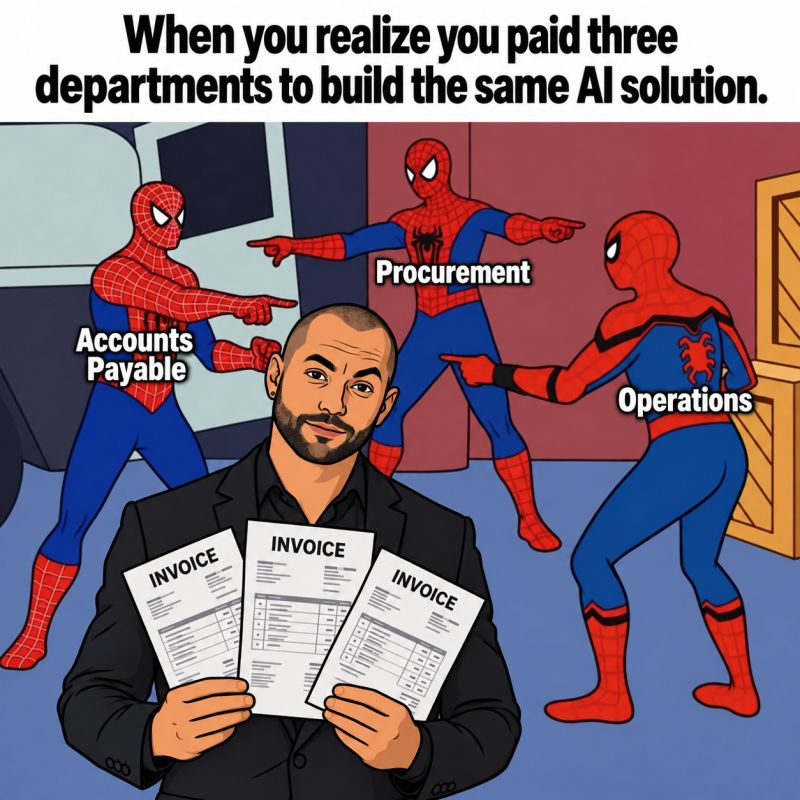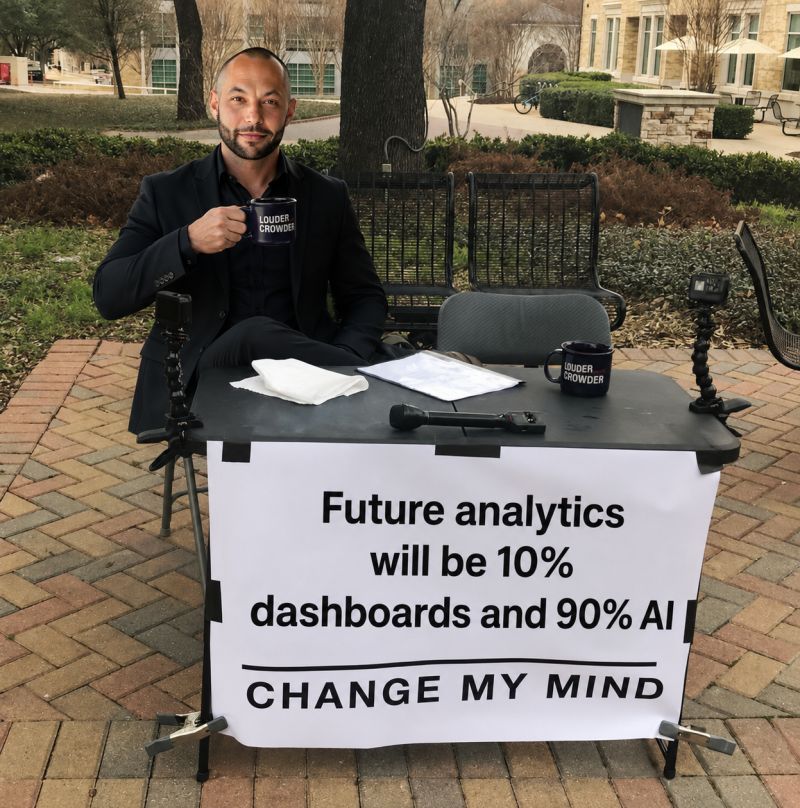
Most organizations still run on 90% dashboards and 10% AI.
That ratio is about to flip.
Dashboards are not going away. They still matter. They create consistency, align teams around shared metrics, give leaders a common source of truth, and help organizations monitor the business.
A good dashboard is still useful.
But most companies have way too many dashboards and not nearly enough decisions.
That is the shift enterprise data leaders need to pay attention to. The future is not just dashboards that display information. It is AI systems that help interpret, recommend, explain, and act.
Dashboards will become the consistency layer. AI will become the decision layer.
Dashboards tell you what happened
A dashboard is excellent at showing movement.
Revenue moved. Pipeline changed. Costs increased. Churn ticked up. Inventory drifted. Conversion dropped. Customer tickets spiked.
That visibility matters. Without consistent metrics, organizations end up arguing about whose spreadsheet is right instead of what decision needs to be made.
Dashboards create a shared measurement layer. They help teams align on definitions, track performance, monitor risk, and identify exceptions.
But a dashboard usually stops at visibility.
After the metric changes, the human still has to ask the next set of questions:
- Why did it happen?
- What changed?
- Who is affected?
- What action should be taken?
- Who needs to know?
- What happens if we do nothing?
That is where dashboards start to show their limits.
AI changes the layer above the dashboard
The next phase of business intelligence is not just prettier charts or faster self-service.
It is systems that connect insight to action.
The dashboard shows the metric. The AI explains the movement.
The dashboard shows the trend. The AI investigates the drivers.
The dashboard shows the exception. The AI routes the issue, drafts the response, opens the ticket, or recommends the next action.
The dashboard says, “Something changed.”
The AI says, “Here is why it changed, here is who is affected, here are the likely options, and here is what I recommend.”
That is a very different operating model.
It moves analytics from passive reporting into active decision support. It turns data from something people inspect into something that helps move work forward.
The old self-service model is not enough
For years, many data teams worked toward a version of self-service analytics that looked something like this:
Build reports. Publish dashboards. Wait for stakeholders to self-serve.
Which often became:
Build reports. Publish dashboards. Watch nobody use them correctly. Get asked for a new dashboard.
Very innovative. Very circular.
The issue is not that dashboards are bad. The issue is that many organizations confuse access to information with better decision-making.
Those are not the same thing.
A sales leader does not only need a dashboard showing pipeline movement. They need to understand what changed, which deals are at risk, what behavior caused the movement, and what action should happen next.
An operations leader does not only need a dashboard showing inventory drift. They need to know whether the drift is noise, a supplier issue, a demand shift, a forecasting problem, or an execution failure.
A customer success leader does not only need a churn dashboard. They need an early-warning system that connects product usage, support tickets, account history, renewal timing, and recommended intervention.
Dashboards can show the signal. AI can help turn the signal into action.
Data teams will have to evolve
This shift will force data and AI teams to evolve.
The job is no longer only to build reports. The job is to build systems that help the business make better decisions faster.
That requires more than a dashboard backlog. It requires:
- Trusted data
- Business context
- Semantic layers
- Workflow integration
- Governance
- Alerting
- Human-in-the-loop controls
- Decision tracking
- Adoption planning
These are not optional add-ons. They are what make AI useful in the decision layer.
If AI is going to explain movement, recommend actions, or trigger workflows, it needs trusted definitions, governed access, clear escalation paths, and a way to connect recommendations to real business processes.
This is dashboard repositioning, not dashboard replacement
This is not dashboard replacement. It is dashboard repositioning.
Dashboards will still be where organizations go for consistency. They will remain important for shared definitions, executive reporting, compliance, monitoring, and broad performance visibility.
But AI will increasingly become where people go for interpretation, exploration, and action.
In many organizations today, the operating model is roughly 90% dashboards and 10% AI.
My prediction is that the future will look closer to 80% AI and 20% dashboards.
Not because dashboards stop mattering. Because the center of gravity moves from looking at information to acting on it.
The companies that lead will not be the ones with the best dashboards. They will be the ones that turn data into decisions faster.
Because the end goal was never “more dashboards.”
The end goal was better business judgment at scale.