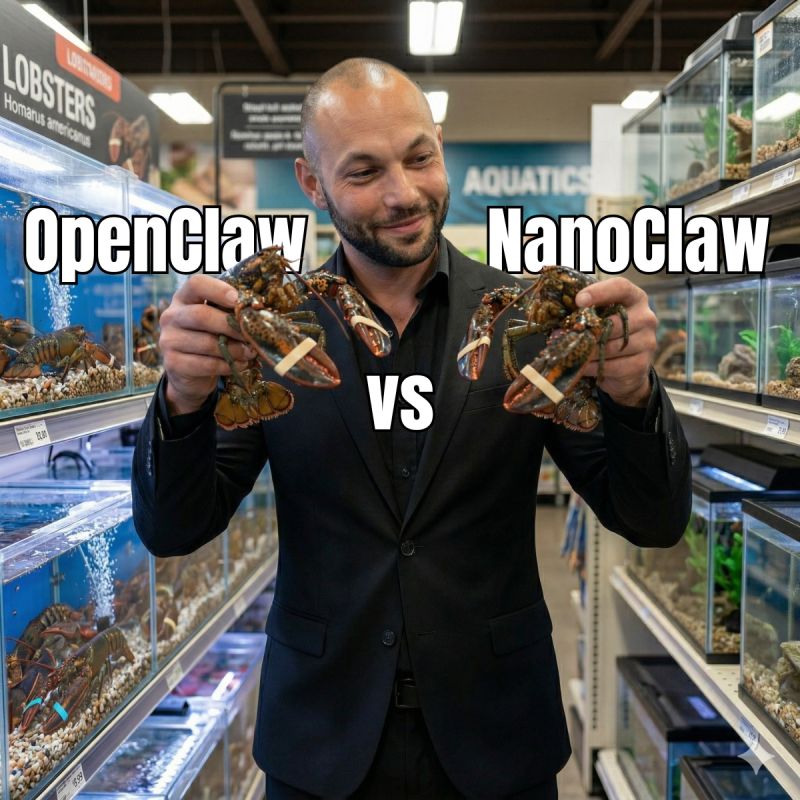
If you are not at least talking about a “Claw” of some sort, you are going to have a problem.
For the last couple of years, most enterprise “AI wins” have lived in a safe lane.
Draft the email. Summarize the meeting. Rewrite the policy. Generate the slide.
Useful, yes, but mostly low-risk. If the model is wrong, the damage is usually limited to “wrong words.”
That era is ending.
We’re moving into the era of AI that acts, systems that do not just recommend the next step, they take it. They click. They run commands. They move files. They trigger workflows across apps and infrastructure.
And when AI can take action, the risk profile shifts from “quality” to control.
That is why the OpenClaw conversation matters. And it is why Nvidia’s NemoClaw matters even more.
So what is NemoClaw, and why does it feel like the missing link between the open-source community and the boardroom?
Let’s break it down.
OpenClaw: the Innovation Engine
Think of OpenClaw as the open-source “innovation engine” for agentic AI.
Instead of stopping at chat, it pushes into execution. It can:
- navigate a desktop environment,
- call tools and APIs,
- execute code,
- coordinate multi-step workflows,
- and operate across systems like a junior operator would.
This is the kind of capability that makes technical teams light up because it shortens the distance between “idea” and “automation.”
But it also triggers the first enterprise gut-check.
If an agent can do real work, then the enterprise questions show up immediately:
- What exactly can it access?
- What actions can it take?
- How do we prevent it from going outside its lane?
- How do we prove what it did, and why it did it?
Without solid answers, powerful open-source agents can look like a black box.
And black boxes do not pass security review.
NemoClaw: the Enterprise Shield
Now imagine taking that same “agent that can act” concept and wrapping it in the controls enterprises need to put it into production.
That is the role NemoClaw is positioned to play.
In plain terms, NemoClaw is about adding governance, boundaries, and auditability to agentic execution.
The kinds of capabilities enterprise leaders care about look like this:
1) Hard boundaries (so agents cannot “escape”)
If an agent can execute workflows, it needs enforced constraints, not just “please behave” prompts.
Enterprise-grade sandboxes and policy controls exist for one reason: to create predictable limits around what an agent can do, even when the model is wrong, confused, or manipulated.
2) Privacy-aware routing (so sensitive data stays where it should)
A lot of enterprise AI failure is not about accuracy, it is about data handling.
Agentic systems touch:
- customer records,
- financials,
- internal strategy,
- source code,
- credentials and tokens,
- and regulated data.
A workable enterprise approach often requires that sensitive data remain on-prem or in a private environment, while only non-sensitive context is sent out to external models or services.
3) Immutable audit trails (so you can answer “what happened?”)
Once agents are acting, “trust me” is not an operating model.
You need to be able to reconstruct:
- what the agent saw,
- what it decided,
- what it executed,
- and what it changed.
Not because you love paperwork, but because:
- regulators will ask,
- customers will ask,
- your board will ask,
- and your security team will definitely ask.
Why enterprise leaders need to care now (not “sometime next year”)
1) Shadow agents are already here
Whether leadership has approved it or not, many teams are already experimenting with autonomous agents.
This typically starts innocently:
- “Let’s try it on this repetitive task.”
- “Let’s automate this daily report.”
- “Let’s let it clean up tickets.”
But “unofficial automation” quickly becomes “unofficial access.”
If you do not provide a governed path, the organization will create an ungoverned one.
2) We are moving from “suggestion” risk to “execution” risk
The old risks were:
- hallucinated facts,
- tone issues,
- bad summaries,
- sloppy drafts.
The new risks are:
- wrong system changes,
- wrong data moved,
- wrong permissions granted,
- wrong workflow executed,
- or right workflow executed at the wrong time.
In other words, the risk shifts from reputational or informational to operational.
3) The “wait and see” backlog is dead
Agentic AI is not a big-bang project you put on a 12-month roadmap and revisit at budget season.
It is iterative by nature:
- pilot quickly,
- constrain tightly,
- learn,
- expand cautiously,
- and instrument everything.
If you treat this like a long waterfall initiative, the organization will outpace you with ad-hoc usage.
What to do this week (a practical starting point)
If you are a CIO, COO, CISO, or data leader, here are concrete steps you can take without boiling the ocean.
- Inventory “where agents are already being used.”
Not just official tools, also browser extensions, scripts, and internal experiments. - Define a “safe lane” workflow to pilot.
Pick one process that is valuable but containable. - Establish minimum governance requirements.
Scoped permissions, sandboxing or isolation, logging and replayability, and clear ownership. - Decide your human-in-the-loop policy.
What requires approval before execution? What can be auto-executed? - Create an incident playbook for agent actions.
Rollback, audit, and corrective action.
Common failure modes (where teams get this wrong)
- Over-trusting prompts as “controls.” Prompts are guidance, not enforcement.
- Skipping audit logs. If you cannot prove actions, you cannot scale adoption.
- Letting pilots quietly become production. This happens constantly.
- Treating this as only a data team topic. Security and ops must be in the room.
- Assuming the first risk will be a leak. Often it is an accidental action with a big blast radius.
Executive takeaway (the boardroom version)
Agentic AI will not be adopted because it is exciting. It will be adopted because it collapses cycle time in real operations.
But it will only scale in enterprises when the governance layer is real: boundaries you can enforce, privacy controls you can explain, and audit trails you can defend.
That is the difference between “interesting demo” and “production capability.”
Closing question
Are you building a “Claw” strategy now, or are you waiting for the first security incident to force one?