Most AI strategy is just expensive theater.
A slide deck. A pilot graveyard. A chatbot no one asked for. And a dashboard that proudly reports “hours saved.” Meanwhile, the leadership team is wondering why the business still feels exactly the same.
That is the part people do not like to say out loud: AI usually does not fail because the model is not impressive enough. It fails because companies try to bolt AI onto a broken operating model and then act surprised when the results do not compound.
The problem is not the model. It is the operating model.
Most companies start with the wrong question: “We bought this tool. What can we do with it?”
That sounds practical, but it is backwards. It puts the software at the center instead of the work. The better question is: “Which workflow matters enough that improving it would change a business outcome?”
AI is not magic dust you sprinkle across an organization. It is leverage. And leverage only helps when it is applied to the right point in the system.
If the workflow is messy, AI makes the mess faster. If ownership is unclear, AI creates more ambiguity. If the data is unreliable, AI produces polished uncertainty. If approvals, escalation paths, and review steps are undefined, AI turns into a very confident intern with access to expensive tools.
The four patterns that turn AI strategy into theater
1. Starting with tools instead of work
“We bought X. What can we do with it?” is the sentence that launches a thousand pilots and very few durable systems.
Tools matter, but they should be selected after the workflow is understood. A sales team trying to shorten cycle time, a support team trying to reduce repeat tickets, and a finance team trying to improve close accuracy do not need the same AI strategy. They need different process changes, different data access, different review points, and different success metrics.
When the tool comes first, teams end up hunting for use cases. When the work comes first, the right tool becomes much easier to identify.
2. Measuring activity instead of outcomes
“Hours saved” is not automatically ROI. It might be useful, but only if those hours turn into something the business can actually measure: revenue, margin, risk reduction, retention, speed, quality, or capacity.
If a team saves ten hours and then absorbs those hours into more meetings, the spreadsheet looks great and the business does not move. That is not transformation. That is productivity cosplay.
A serious AI initiative defines the business result before it defines the demo. Incremental revenue. Shorter cycle time. Fewer escalations. Lower error rates. Faster onboarding. Better renewal coverage. Pick the outcome, assign an owner, and decide how it will be measured before the pilot starts.
3. Treating governance like cleanup
Governance often shows up after the fire: after sensitive data gets pasted somewhere it should not, after legal gets nervous, after a customer-facing output goes sideways, or after the board asks who approved the thing that no one technically approved.
That is too late. Governance is not the enemy of speed. Good governance is what makes speed safe enough to scale.
Approved data sources, logging, human review points, escalation paths, permissions, rollback plans, and clear accountability are not bureaucratic decoration. They are deployment infrastructure. Without them, the organization can experiment, but it cannot confidently operationalize.
4. Turning everything into one giant AI program
“The AI program” sounds official. It also becomes a black hole if everything gets shoved into it.
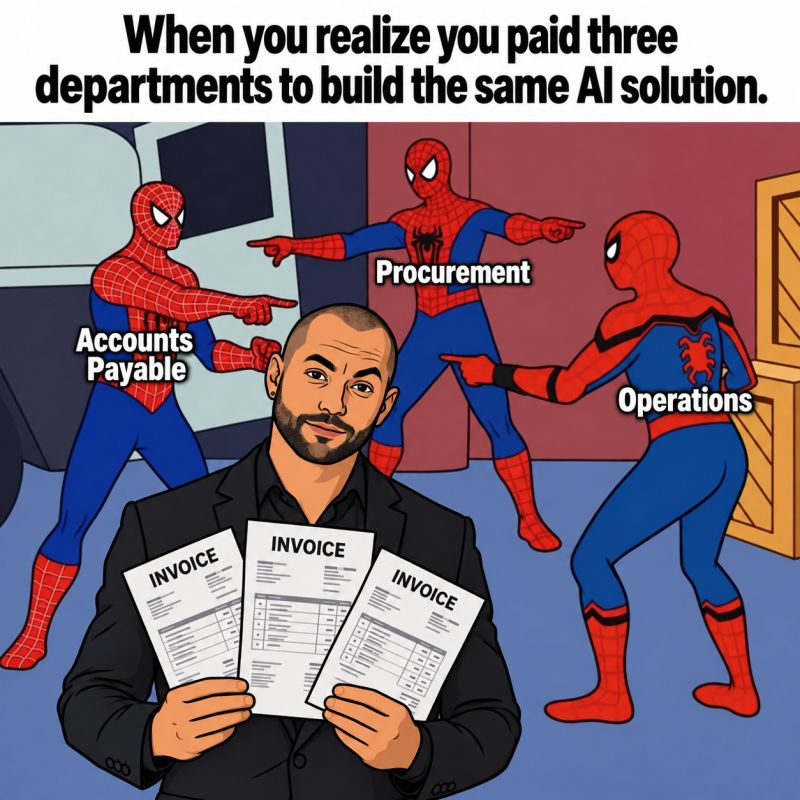
When every department, workflow, pilot, vendor, risk, training need, and dashboard is bundled into one mega-initiative, ownership gets blurry. Teams can point to motion, but not always to results. Everyone is involved, which often means no one is accountable.
The better pattern is smaller, sharper, and more honest: pick a workflow, define the dollar outcome, redesign the operating process, build the guardrails, instrument the system, and then expand from what actually worked.
The operating model that actually works
If you want AI to compound, run it like a business system, not a science project.
Pick one revenue-adjacent workflow
Start with something that matters, not something easy.
- Sales cycle time
- Renewals
- Claims processing
- Support deflection
- Customer onboarding
- Forecasting accuracy
The best first use case is close enough to revenue, margin, risk, or customer experience that the business already cares whether it improves. If the workflow does not matter without AI, it probably will not matter with AI.
Define “done” in dollars
Before building anything, write down what success means in business language.
- Incremental revenue
- Margin improvement
- Risk avoided
- Retention lift
- Cycle time reduction
- Error reduction
Then put an owner on it. Not a committee. Not a steering group. An owner.
AI systems improve when there is a tight loop between usage, feedback, measurement, and iteration. That loop breaks when nobody owns the outcome.
Redesign the workflow before touching the model
This is the step everyone wants to skip because it feels less exciting than a demo. It is also the step that determines whether the demo becomes a system.
Map the work. Identify the decisions. Clarify the handoffs. Remove unnecessary steps. Decide where AI should assist, where it should automate, where it should summarize, where it should recommend, and where a human should stay firmly in the loop.
AI does not fix unclear process. It exposes it.
Build guardrails before scale
Guardrails are not just policy documents. They are product requirements.
- Which data sources are approved?
- Which actions require human review?
- What should be logged?
- What happens when confidence is low?
- Who can override the system?
- How do you roll back if something breaks?
Answering those questions early is what lets a company move from “interesting pilot” to “operational capability.”
Instrument everything
No measurement means no learning. No learning means no compounding.
Instrumentation should capture both system performance and business performance. Did the AI produce usable outputs? Did humans accept, reject, or edit them? Where did the workflow slow down? Which failure modes repeated? Did the target business metric actually move?
This is where AI strategy becomes operational discipline. The goal is not to launch a model. The goal is to create a system that gets better because the organization can see what is happening.
The executive takeaway
If your AI strategy cannot be explained as, “Here is the workflow we are changing, here is the dollar outcome, and here are the guardrails,” it is not a strategy.
It is a deck.
The companies that win with AI will not be the ones with the most pilots, the biggest slideware, or the loudest internal launch campaign. They will be the ones that treat AI as part of the operating model: tied to work, owned by the business, measured in outcomes, governed before scale, and improved through feedback loops.
That is when AI starts compounding.