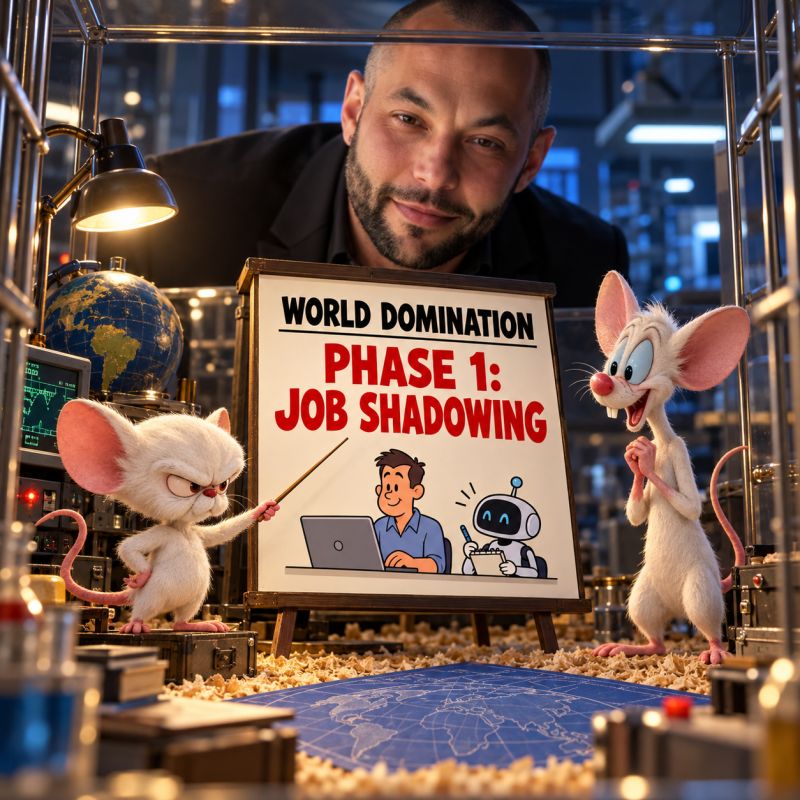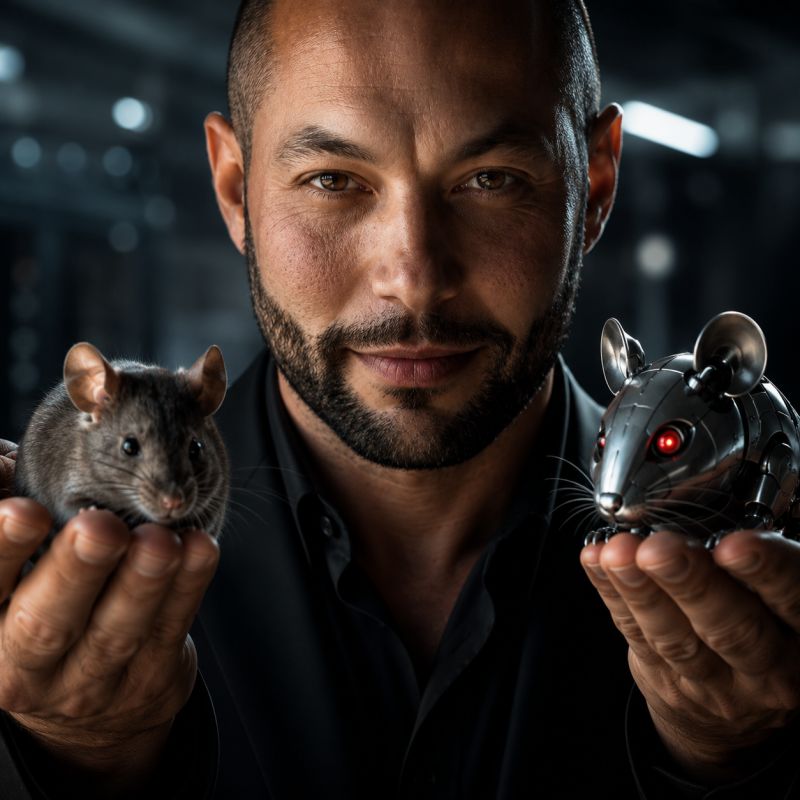
A mouse experiment foreshadowed one of the biggest fears about AI.
Not unemployment.
Irrelevance.
The “Calhoun effect” is one of the darker metaphors for the AI era because it points at something deeper than job displacement. It points at role collapse.
John B. Calhoun’s famous mouse utopia experiments were built around abundance. The mice had food, water, shelter, and no predators. At first, the environment looked ideal. Survival pressure had been removed.
But over time, the colony began to break down. Some mice became aggressive. Some withdrew. Some stopped mating, parenting, competing, or participating altogether. The colony did not collapse because it lacked resources. It collapsed because the social structure lost coherence. Roles disappeared. Contribution disappeared. Purpose disappeared.
That is the uncomfortable parallel with AI.
A lot of the public conversation around AI is still framed as a labor market story: which jobs will be automated, which tasks will be replaced, which industries will be disrupted. That conversation matters, but it is incomplete. The deeper fear is not only that machines will take jobs. The deeper fear is that humans will lose the roles that make them feel needed.
The fear is not just job loss. It is role absence.
People are quietly asking questions that are more personal than economic.
- If AI can write, what is my role as a writer?
- If AI can code, what is my role as an engineer?
- If AI can design, analyze, summarize, sell, plan, and teach, where do I fit?
- What do I contribute that is still needed?
- How do I earn status, dignity, security, and identity in a world where competence is increasingly automated?
Those are not small questions. They are identity questions.
Work has never only been about income. Work gives people rhythm. It creates responsibility. It gives people a place to be useful. It establishes hierarchy, community, challenge, reputation, accountability, and identity. For many people, work is where they prove competence. It is where they earn trust. It is where they feel that their effort matters to someone other than themselves.
If AI removes tasks without creating new forms of contribution, the disruption will not be merely economic. It will be psychological and social.
Abundance without agency is not the goal
The optimistic story of AI is abundance. More output. More leverage. More creativity. More productivity. More access to expertise. More people able to build, learn, analyze, and express themselves with fewer barriers.
That story is real. AI can remove friction from work that used to be slow, expensive, or inaccessible. It can give small teams the leverage of large teams. It can help non-technical people create technical things. It can help technical people operate at a higher level. It can compress the distance between idea and execution.
But abundance alone is not enough.
If people are surrounded by intelligent systems but have no meaningful responsibility, abundance can start to feel like displacement. If AI does the visible work, makes the first draft, writes the code, generates the strategy, summarizes the meeting, drafts the design, and recommends the decision, humans can begin to feel like spectators in systems they used to operate.
That is the real danger: not that AI makes humans useless, but that organizations accidentally design work in ways that make people feel useless.
The wrong question is what humans can still do better
A lot of leaders are asking the wrong question.
They ask: “What tasks can humans still do better than AI?”
That question is understandable, but it is a shrinking frame. The list of tasks where humans have a clear, durable, technical advantage will keep changing. Writing, coding, analysis, design, research, customer support, planning, teaching, and management will all be reshaped by AI systems that get cheaper, faster, and more capable.
If the human role is defined only by what the machine cannot do yet, then the human role becomes a defensive position. People end up waiting for the next capability jump to take another piece of their identity.
The better question is different:
What responsibilities, relationships, judgments, tastes, missions, and forms of ownership should humans take on now that intelligence is becoming abundant?
That question creates room for redesign. It moves the conversation from task protection to role evolution.
Human work has to move up the responsibility stack
The future of work is not humans doing every task manually while AI waits politely on the side. That is not realistic. It is also not the highest use of human potential.
Human work has to move toward ownership, judgment, taste, coordination, accountability, ethics, strategy, and relationship-building.
In an AI-enabled organization, the human role should not disappear. It should become more explicit. Humans define the mission. Humans choose what matters. Humans set constraints. Humans decide which tradeoffs are acceptable. Humans interpret context that is political, emotional, cultural, or strategic. Humans own the consequences when systems act.
That means the most important question for leaders is not simply how to automate work. It is how to redesign work so people remain meaningfully responsible.
A team using AI well should not feel like a group of people being slowly hollowed out by software. It should feel like a group of people with more leverage, clearer ownership, faster learning cycles, and more room to focus on what actually requires human judgment.
Leaders need to design new roles, not defend old ones
The AI era does not have to end in human irrelevance. But avoiding that future will require more than reskilling programs and productivity dashboards.
Leaders need to redesign roles instead of merely defending old ones.
That means asking what forms of agency people will have when AI systems handle more execution. It means deciding where humans must remain accountable. It means creating career paths around orchestration, judgment, domain expertise, creative direction, systems thinking, and responsible automation. It means giving people ownership over outcomes, not just a queue of tasks.
It also means being honest about the emotional side of transformation. People do not resist AI only because they are afraid of tools. They resist it because they sense, often correctly, that their role in the system is being renegotiated without them.
If leaders want adoption, they need to answer the human question: where do I fit now?
AI can remove friction. It cannot manufacture purpose.
AI can make work faster. It can make expertise more accessible. It can remove repetitive tasks. It can help people create more than they could before.
But it cannot automatically give people purpose.
Purpose comes from agency, contribution, responsibility, community, and ownership. It comes from being needed in a way that feels real. It comes from having a role that matters.
A future of abundance can become a behavioral sink if people are reduced to spectators.
But it can become something entirely different if people are given agency, ownership, creative leverage, and meaningful responsibility.
AI will change what humans do.
It does not have to erase why humans matter.