If you want AI to take over all the jobs, you first need to give it an org chart.
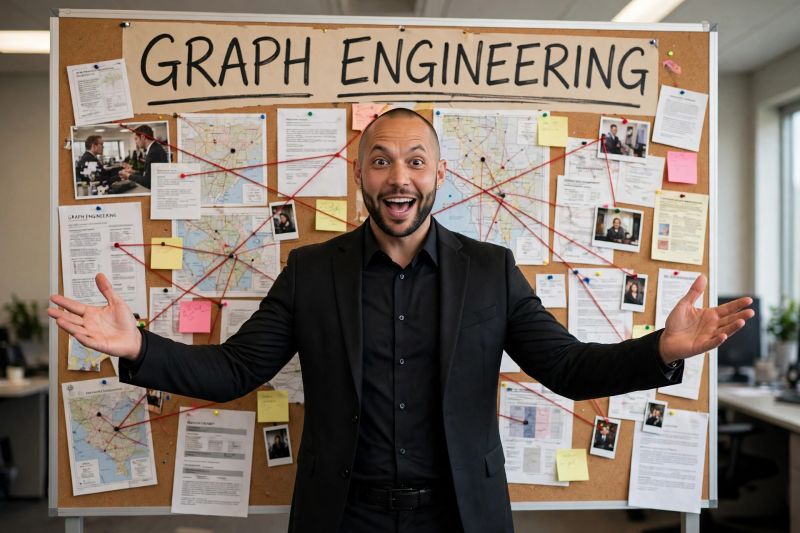
Welcome to graph engineering.
Yes, we have reached the stage where the bots need reporting structures.
The concept is simpler than the name.
Prompt engineering is about what you tell an AI. Context engineering is about what it needs to know. Harness engineering is about the tools, permissions, and controls it gets. Loop engineering is about how one agent keeps working until its job is complete.
Graph engineering zooms out.
It designs how multiple agents, tools, systems, and people work together to deliver a business outcome.
Think about employee onboarding. HR verifies the employee and collects information. IT creates accounts. Security assigns access. Finance sets up payroll. A manager confirms that the new hire has what they need to start.
Today, this process is usually held together by workflows, tickets, emails, and one person who somehow knows IT ignores the first ServiceNow notification.
Now replace parts of that process with AI agents.
An HR agent gathers the information. An IT agent provisions accounts. A security agent checks access. A payroll agent completes the finance work. Each has its own instructions, context, tools, and authority.
The graph defines how they work together:
- What information moves between them?
- Which work can happen in parallel?
- Who can approve which decision?
- What happens when a system fails or data is missing?
- When does a human need to step in?
The easiest way to understand it is this:
A loop is how one AI employee does its job.
A graph is how an AI organization gets work done.
That distinction matters because valuable enterprise processes rarely live inside one prompt. They cross departments, applications, data sources, approvals, and exceptions.
A well-designed graph lets organizations use specialized agents instead of one giant AI expected to do everything. Different models can handle different work. Tasks can run in parallel. Failures can be routed to the right owner. Humans can focus on judgment, high-risk approvals, and exceptions.
That is the exciting part.
The harder part is that we can recreate every organizational problem we already have, except at machine speed.
Who owns a decision? Which agent can access what? What happens when two agents disagree? How do you audit a decision five handoffs later? Who gets blamed when six AI agents collaborate perfectly to produce the wrong answer?
That is why graph engineering is not “add more agents.”
It is architecture: routing, permissions, memory, monitoring, fallbacks, security, governance, and clear human escalation.
And not everything needs it. If one agent and a simple loop can reset a password, use one agent. We do not need six AI specialists, an orchestration layer, and a steering committee to do what a self-service portal should have handled in 2014.
But when work crosses functions and systems, the graph becomes the operating model.
If we want AI to do more of the jobs, step one is the same as it has always been:
Give everyone a job.
Then figure out who reports to whom.