Most teams don’t fail because they chose the wrong hybrid stack. They fail because, somewhere along the way, they never re-establish who owns the decision boundary.
Decision ownership isn’t about build vs. buy
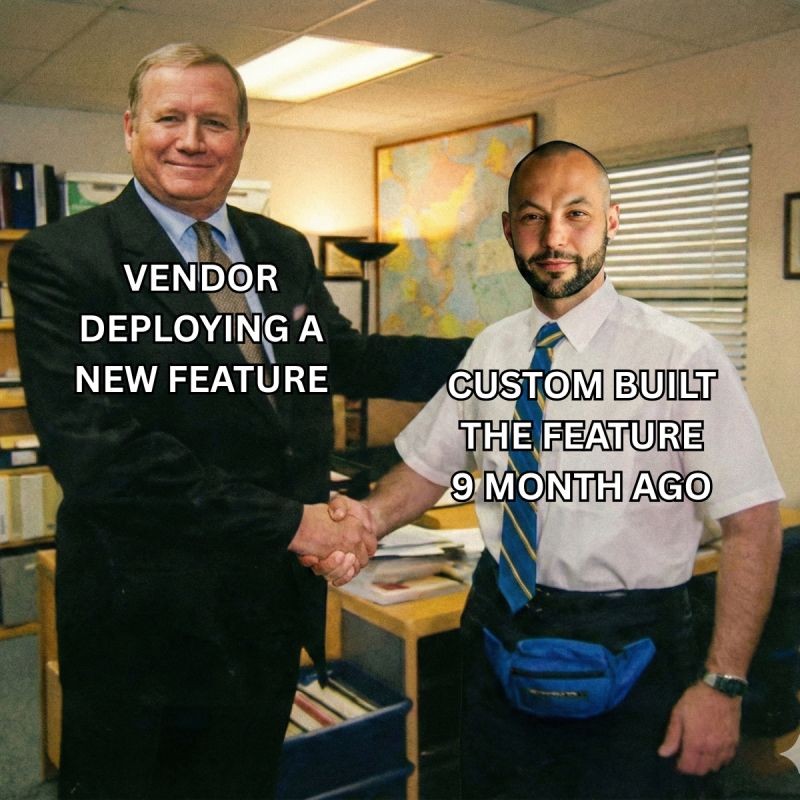
When vendors ship a new feature into your environment, the expensive part is not duplication—it’s discovering too late that your bespoke logic became the system’s spine, and nobody owns the rollback authority. You need a governance code that mirrors the coupling you create.
Five dimensions of custody
- Roadmap ownership: who decides which parts stay in-house?
- Failure models: who tracks the risks and owns the mitigations?
- Rollback authority: who can pause or reverse the system?
- Exit cost: what stops you from walking away if the hybrid stack misbehaves?
- Transparency: does every operator know whose opinionated logic is running?
If you can’t answer those five questions before your hybrid goes live, leverage quietly flips to the vendor once the coupling spreads.
Make the governance axis visible
Coupling hides in plain sight. Build a table that maps every system component to decision custody, failure owners, and exit options. Share that with execs so the conversation stays rooted in clarity, not hype.
- Assign a decision owner for every workflow.
- Log failure modes and the people responsible for them.
- Document rollback procedures and who can trigger them.
Make those cards accessible wherever agents run so teams can see who has authority before they act.
Signals that the vendor owns too much
- Decision creep: more business outcomes depend directly on the vendor’s system.
- Alert fatigue: operational notifications without context or ownership.
- Rollback latency: it takes too long to stop the coupling when it misbehaves.
Measure those signals weekly and tie them to clarity metrics so you can sense leverage shifting.
Re-establish boundaries with a playbook
The fix isn’t more automation; it’s a governance playbook. Run tabletop drills, attach decision cards to every agent, and rehearse exit scenarios.
- Identify the workflows the vendor owns and assign internal guardians.
- Document the policy/prompt/exception path for each decision.
- Create dashboards that visualize decision latency, escalation rates, and rollback readiness.
The goal: keep the vendor from dictating terms while you still get the speed of hybrid systems.
The long view
Hybrid architectures succeed when clarity holds the scaffolding together. Craft those governance structures now so you can step forward confidently—and so the leverage never quietly flips away from you.