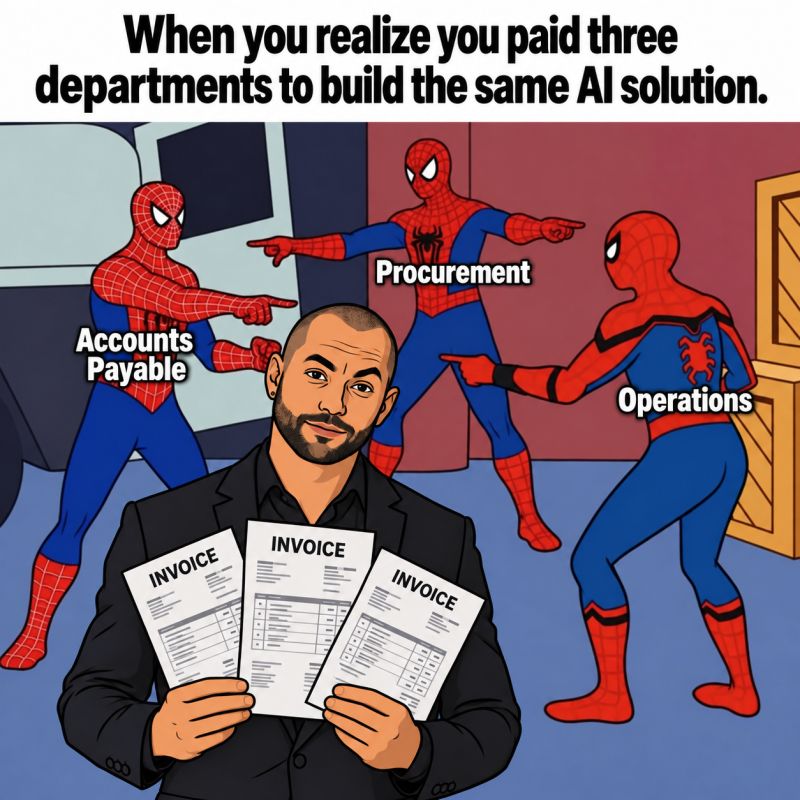
You followed the AI playbook; buy tools, train people, facilitate adoption. Nobody mentioned you might be funding the same build multiple times across departments.
Does this sound familiar …
Accounts Payable is drowning in invoices. PDFs, scans, and emails from hundreds of vendors, every one in a different format. The team builds document AI to extract invoice numbers, purchase orders, line items, totals, and due dates, then send the information into the ERP.
There is real work behind that apparently simple process. Messy layouts. Multi-page tables. Exceptions. Approval requirements. Eventually it works, manual keying drops, and the team is proud of what it built. It should be.
Procurement never sees it.
That is where a successful adoption story can quietly become an expensive coordination problem.
One document problem, three separate solutions
Consider how the same pattern can develop across departments. Procurement has its own document problem: purchase orders, vendor contracts, and receiving paperwork. So it chooses another vendor and builds another extraction tool.
The workflow is different, but parts of the underlying problem are familiar: reading supplier documents, handling multi-page line items, recognizing tax and freight fields, and connecting the result to a business system.
Operations never sees either solution. Its team builds a third pipeline for packing slips, bills of lading, and supplier invoices, matching paperwork against what actually arrived.
Third tool. Third integration into the same ERP. Third team responsible for keeping it running.
Each project can make sense when viewed inside its department. The duplication only becomes obvious when someone looks across the work.
The cost is bigger than three subscriptions
Licenses and per-page processing charges are the visible costs. The less obvious costs sit in everything the teams repeat around them.
They evaluate vendors separately, prepare similar examples, build overlapping extraction logic, tune exception handling, implement integrations, and establish support routines. When something changes, each team has its own repair work to do.
Now imagine the same supplier invoice passing through those three pipelines. Accounts Payable extracts one total. Procurement produces another. Operations matches against a third interpretation. Finance gets the privilege of reconciling the disagreement.
Different treatment of freight, tax, credits, or multi-page line items can create a mismatch even when every team believes its own system is working. Without reconciliation and payment controls, that kind of mismatch can contribute to late payment, duplicate payment, or a month-end argument about which number is right.
When a vendor changes an invoice format, one team might fix its extraction logic while the others do not know anything changed until their own processing fails.
The business has not just bought overlapping software. It has created overlapping maintenance responsibilities and multiple interpretations of the same document.
This is not an adoption failure
The teams adopted the tools. They learned how to use them. They solved problems close to the work. None of that should be dismissed.
The missing piece is visibility: what already exists, what it can do, who owns it, and whether another department can build on it.
A company can have strong tool usage and still struggle to turn departmental wins into shared capability. If every team has to rediscover what another team already learned, adoption keeps generating activity without capturing all the value it could.
That is the awkward part for leaders who have done what the AI playbook told them to do. The next constraint may no longer be getting people to use AI. It may be helping those people see and reuse each other’s work.
Shared capability does not mean identical workflows
Accounts Payable, Procurement, and Operations do not need the same application. They have different responsibilities, approvals, and definitions of a completed task.
They may still benefit from common components: document ingestion, extraction of shared fields, supplier identifiers, an agreed data structure, tested ERP connections, and a reusable way to flag uncertain results.
That distinction matters. If reuse means forcing every department into one giant workflow, teams have a good reason to avoid it. If reuse means starting with a proven component and keeping the business-specific steps they need, the proposition becomes more useful.
Nor does using a common platform automatically solve the problem. Teams can recreate the same capability inside the same platform if nobody knows where to find it or whether it is supported.
The goal is to make a useful asset discoverable and practical to adopt, not merely to make the technology stack look tidier.
Make the work visible before funding the next build
Start with a concrete workflow family, such as supplier-document processing. Identify the solutions already in use and the problems each one handles. A list of model subscriptions is not enough.
For each asset, record its business purpose, owner, users, supported document types, outputs, integrations, access boundaries, and known limitations. Include how another team would actually request access or support.
Then compare the overlap. Which parts are genuinely reusable? Which need department-specific logic? Which solutions are experiments, and which are business dependencies that deserve an explicit support commitment?
This makes the next investment conversation more specific. Instead of asking only whether a proposed project is valuable, ask what it can reuse, what new capability it adds, and who else could benefit from that addition.
The point is not to turn every small experiment into a long approval exercise. It is to give teams a quick way to discover that someone has already solved part of their problem.
Reuse needs an owner, not just a catalog entry
An asset is not ready to become shared infrastructure because somebody uploaded a description to an internal page.
Someone needs to own its supported behavior, communicate changes, and explain what happens when it fails. In the invoice example, that includes agreeing on field definitions, testing against representative supplier formats, and understanding which dependent workflows might be affected by an update.
Shared extraction also does not require giving every department access to every document. Reuse can apply to the component, its output contract, or its integration pattern while the underlying data remains appropriately restricted.
Those are the details that make reuse a credible choice. Without them, a team may reasonably decide that building its own version is the only way to get a dependable result.
Measure the value across departments
Look beyond usage counts and local time savings. Track the build work avoided, integration work reused, ongoing support effort, processing costs, and reconciliation problems across the whole workflow.
That does not mean every apparent overlap should be consolidated. Distinct requirements may justify separate tools. The improvement is being able to make that decision deliberately rather than discovering the duplication after the invoices arrive.
Three builds, three processing bills, three integrations, and three maintenance burdens may be justified. Or they may be a shared capability that three teams could have built on.
You need visibility to tell the difference.
That is the visibility gap we are focused on at ALKU Intelligence: helping organizations connect the useful work already happening across the business, so successful adoption does not keep creating avoidable duplication.
If the invoice example sounds familiar, reach out to me or Chris Ferrara. The next opportunity may already exist inside your company. Another team just has not seen it yet.