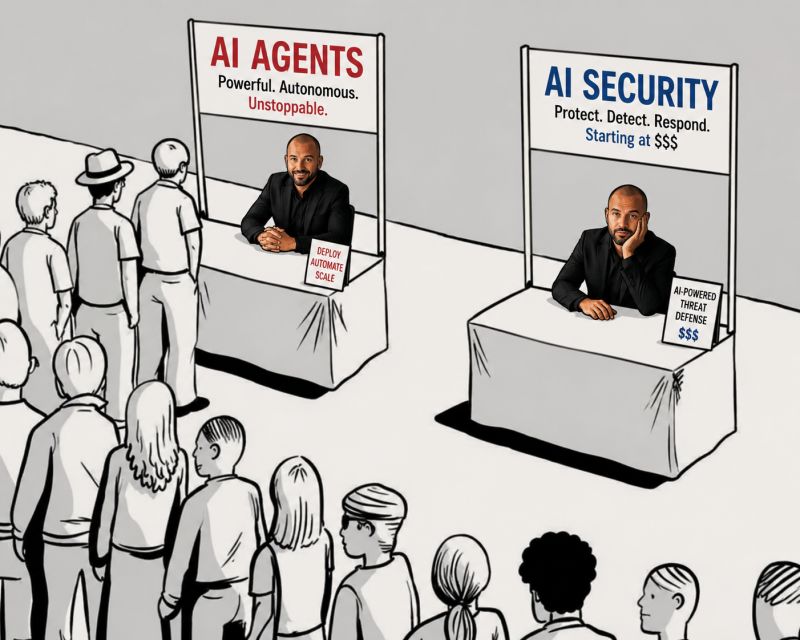
Your AI system does not have an intelligence problem. It has a middle-management problem.
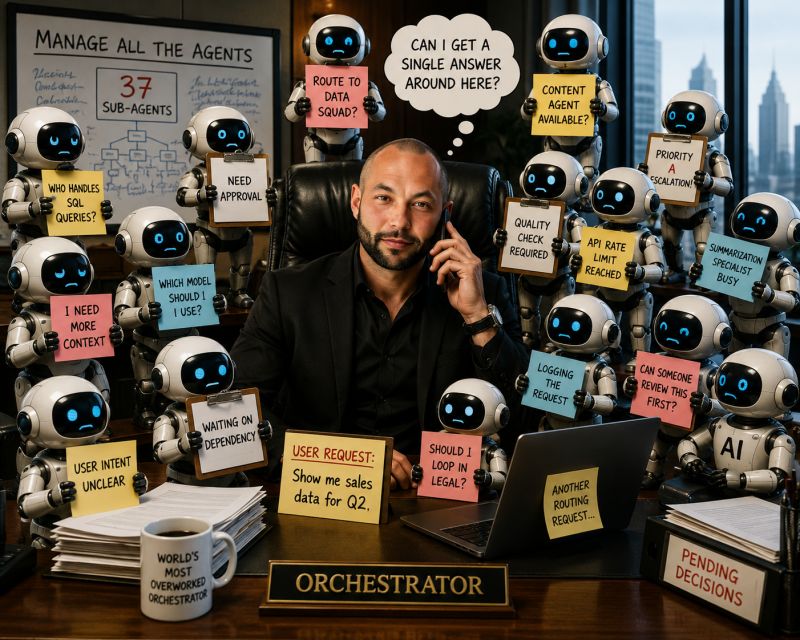
I recently audited a multi-agent architecture where a single orchestration agent was trying to manage 37 sub-agents.
On paper, it looked brilliant: maximum specialization, perfect encapsulation, ultimate flexibility.
In reality, it was a corporate nightmare. The orchestrator spent so much time playing traffic cop that it forgot to actually get work done.
Imagine walking into a restaurant, ordering a burger, and watching the waiter ask a manager, who asks a regional director, who consults a burger specialist, who loops in a quality assurance analyst. Twenty minutes later, nobody has even turned on the grill.
That is exactly how many agentic AI systems are being built today.
The Coordination Tax of Multi-Agent Systems
Multi-agent architectures are attractive for a good reason. Specialization makes sense. A data agent should not do the same job as a content agent. A compliance agent should not behave like a customer support agent. A workflow agent should not be responsible for deep research.
But specialization has a cost: coordination.
When one central orchestrator is responsible for deciding which of dozens of agents should handle every request, the architecture can become slower, more expensive, and less reliable than the simple system it was supposed to improve.
Latency increases as sequential LLM calls stack up. Token consumption grows because every routing decision requires more context. Routing accuracy drops because the model is forced to pick from a massive menu of similar-sounding agents. And debugging gets harder because failures are spread across prompts, tools, memory, routing decisions, and agent handoffs.
The orchestrator becomes the ultimate bottleneck. The architecture designed to make AI smarter just makes it slower.
Do Not Give One Agent 37 Direct Reports
A CEO does not micromanage 37 individual contributors. Neither should your orchestrator.
The better pattern is hierarchical architecture. Break the system into domains. The main orchestrator should talk to a small number of team-lead agents: for example, Data Squad, Content Squad, Admin Squad, Compliance Squad, or Support Squad.
Each squad lead then manages a smaller group of highly specialized agents. That keeps context smaller, routing cleaner, and decisions sharper.
This is not bureaucracy. It is management design.
The goal is not to create an org chart for the sake of it. The goal is to reduce the coordination tax so the system can actually perform.
Stop Using LLMs as Directory Services
One of the most common mistakes in multi-agent design is asking an LLM to inspect every available agent description before deciding what to do.
That is madness at scale.
If a user asks a simple question, the system should not spend seconds asking a model to reason through 37 possible agents. Use semantic routing instead. Convert agent capabilities into embeddings. When a request comes in, run a fast similarity search and pass only the top two or three relevant options to the orchestrator.
That changes the orchestration problem. The model is no longer picking from a giant menu. It is choosing from a short, relevant shortlist.
That is how you trade seconds for milliseconds.
Not Every Sub-Agent Deserves a Soul
Another failure mode is turning every small capability into a full agent.
If something fetches SQL rows, formats dates, calls an API, triggers a webhook, or validates a field, it is probably not an agent. It is a tool.
Giving that capability its own prompt, memory, routing description, and reasoning loop may feel flexible, but it adds overhead where deterministic software would be faster and more reliable.
Use agents where judgment, ambiguity, planning, or language understanding matters. Use tools where the task is narrow and predictable.
Not every Python script needs a soul.
Use Graphs When the Workflow Is Predictable
If your workflow is predictable, stop forcing the orchestrator to guess the next step.
When Agent A always passes data to Agent B, and Agent B is always reviewed by Agent C, that is not an open-ended reasoning problem. That is a workflow.
Use a deterministic graph-based state machine. Make the sequence explicit. Let the agent reason where reasoning is needed, but do not make it rediscover a path the business already knows.
Ditch the GPS when there is only one road.
Run Independent Work in Parallel
Too many agentic architectures behave like they are waiting for permission slips.
If three tasks are independent, run them concurrently. Do not make the user wait while the research agent finishes before the data agent starts, if the data agent did not need the research output in the first place.
Parallel execution is not a nice-to-have. It is one of the biggest differences between a multi-agent system that feels intelligent and one that feels like it is running on dial-up.
The Future Is Not More Agents
The future of enterprise AI is not about building a massive army of agents.
It is about minimizing the coordination tax between them.
That means fewer giant hub-and-spoke designs. More domain squads. More semantic routing. More tools where tools belong. More deterministic workflows where the path is known. More asynchronous execution when tasks can run in parallel.
Multi-agent systems do not fail only because the agents are not smart enough.
They fail because nobody designed the management layer.